Fast Food Equipment Costs Cut by 40% A New Strategy for Precision OEM Manufacturing
Introduction
The purchasing cost of the kitchen appliances, customized serving counters, and even shop sign ages for fast-growing franchises is always exorbitant. Constant malfunctioning and expensive repairs significantly cut into razor-thin profit margins. In many cases, the conventional practice of equipment purchase fails to consider the intricacies involved in component production. Many companies, unaware of their material characteristics and methods of processing, find themselves with too complex designs or incorrect materials, paying for extra effort when there should have been none.In this paper, I will introduce some new concepts from precision manufacturing that can effectively address cost issues using OEM part manufacturing and Design for Manufacturing.
Why Is Choosing the Right Material the First Step to Controlling Fast-Food Equipment Costs?
Material selection directly determines both performance and cost in fast-food equipment. A common dilemma is aluminum vs titanium for OEM parts. While titanium offers superior strength-to-weight ratio and corrosion resistance, its cost—both raw material and machining—is dramatically higher.
The Society of Manufacturing Engineers(SME) take fry baskets as an example. A leading chain replaced titanium alloy baskets with 6061-T6 aluminum alloy. This switch reduced material costs by over 60%. More importantly, aluminum’s excellent machinability significantly lowered overall OEM parts machining expenses. Through surface treatment like hard anodizing, aluminum achieves corrosion resistance approaching that of titanium, yet at roughly one-tenth the cost.
As far as the construction of kitchen components in fast food restaurants, where the operating conditions are neither extremely corrosive nor high temperature, then aluminum is the best material from all perspectives of cost, strength, and weight. The use of titanium is justified when the component must operate under highly durable conditions, such as those experiencing exposure to heat or constant contact with acidic foods.
How Can Design Optimization Reduce Equipment Part Manufacturing Costs by 30%?
There are already established methods that can be used to decrease production expenses without impairing the functionality of the product. For instance, take the example of the customized counter support bracket that was initially created with an excess number of holes of varying sizes and with tight tolerances. In such a case, each individual feature would require special tooling and setup operations, thus increasing the price per unit.
Using dfm design services would help simplify geometry, make all holes equal and use standard thread sizes, as well as loosen the tolerance for noncritical surfaces. It would reduce the need for tooling changes by 50%, as well as shorten the machining process by 35%. It would directly affect unit price, reducing it by 30%.
The main idea behind the precision manufacturing design is that one should think about the manufacturing process even at the stage of creation of the product. The most important DFM tips are as follows: minimize the depth of cavities, avoid using internal corners, use standard drill size, and have enough wall thickness. For newbies in the sphere of DFM, looking through the guide on OEM CNC machining can be very helpful.
How to Identify a Reliable CNC Parts Manufacturer for Long-Term Supply?
Choosing an appropriate CNC machining parts vendor cannot be limited to checking their samples. A company’s reliability can only be ensured by a high-quality performance in each production batch at large volumes. The presence of such certifications as IATF 16949 for automotive or AS9100D for aerospace indicates that a company follows strict processes even if it is not required in the fast-food industry.
Process control abilities for OEM CNC machining services in high volumes
l Real-Time Control by Statistical Process Control
It provides continuous monitoring of crucial dimensions without any defects. In this case, there will be no need for expensive adjustments and reworking.
l Low Defects Rates
Good manufacturers have defects rates less than 0.5%. Thus, you will receive OEM machined components that fully comply with your specifications.
Other Criteria of Supplier Evaluation
Apart from process control ability, evaluate production capabilities of the company—is able to manufacture millions of parts after prototyping? Examine such equipment as coordinate measuring machines and machine vision. Make sure that the supplier has low lead times and fast response rates regarding changes in engineering.
How to Balance Precision and Cost for Best Value in Mass Production?
In mass production, every micron of tolerance carries a price tag. Tightening a general tolerance from ±0.1mm to ±0.05mm can double or triple machining costs due to additional passes, slower speeds, and more frequent inspection. The key is applying strict tolerances only where functionally necessary—such as bearing seats or mating surfaces—while relaxing them on cosmetic or clearance features.
Modern factories leverage automation to reduce labor costs. Robotic loading systems and in-process gauging enable 24-hour unattended production, dramatically lowering per-part overhead. When combined with precision manufacturing design principles, even complex geometries become cost-effective.
Consider a component originally requiring 5-axis machining due to compound angles and undercuts. After redesign using DFM guidelines, it was producible on a standard 3-axis mill with a simple indexing fixture. The per-part savings exceeded 70.For annual volumes of 10,000 units, that represents 700,000 in direct savings.Volume also drives economies of scale. Setup costs, programming time, and fixture fabrication are fixed expenses spread across total quantity. Ordering 50,000 units instead of 5,000 can reduce per-unit cost by 20–40%. Therefore, consolidating orders and planning long production runs maximizes the value of high volume OEM CNC machining services.
What Is Design for Manufacturing, and How Does It Prevent Millions in Rework Losses?
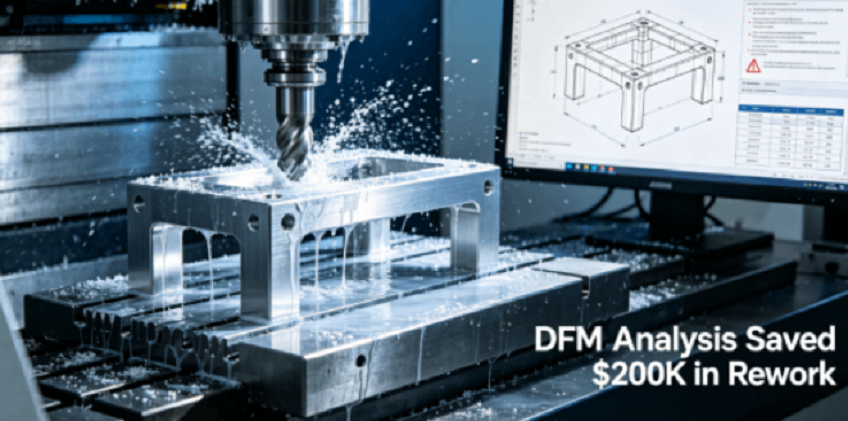
A cautionary tale: A restaurant chain ordered custom refrigerated cabinet handles cast from aluminum. The design lacked any draft angle—a critical requirement for mold release. Hundreds of castings were scrapped, costing over $200,000 in wasted material and lost production time. This disaster could have been avoided with a simple DFM review.
Core Principles of DFM for CNC machining
l Simplify Geometry and Standardize Features
Fewer complex shapes and common hole sizes reduce tool changes and machining time. Standardized threads eliminate special tooling, cutting per-part costs.
l Ensure Tool Accessibility and Avoid Over-Specification
Design features must be reachable by standard cutters. Relax tolerances on non-functional surfaces to avoid unnecessary passes and inspection steps.
The Value of DFM design services
Early DFM analysis—costing only a few hundred dollars—prevents scrap and rework worth tens of thousands. Integrating DFM from day one ensures faster launches and lower total ownership costs.
Conclusion
For fast-food chains pursuing cost leadership, integrating precision manufacturing thinking into equipment procurement is no longer optional—it is essential. From intelligent material selection (aluminum vs. titanium), to adopting Design for Manufacturing, to vetting reliable partners, each step holds significant cost-saving potential. This is not just about individual purchase costs; it defines the long-term efficiency and stability of the entire supply chain.Take immediate action to optimize your equipment supply chain. Visit our website to obtain a free DFM analysis report and learn how to reduce your next OEM project costs by 40%.
Author Bio
Jane Smith, Senior Manufacturing Engineer, focuses on delivering OEM parts machining services to various industry clients. As an experienced professional with more than 15 years of practice designing manufacturing processes that increase product efficiency and performance, she aims at assisting organizations in realizing sustainable production practices.
FAQs
Q1: What is OEM CNC machining?
OEM CNC machining is the mass-production process involving the manufacturing of customized precision metal or plastic parts for original equipment manufacturers. It is a scalable production technology providing all manufactured parts with consistently high quality.
Q2: Can I get competitive pricing for small batch sizes?
Yes. In spite of small batches, with proper DFM services, the design optimization can decrease the cost of each part manufactured. Numerous manufacturers use a wide range of pricing models starting from prototyping through to mass production.
Q3: How to select aluminum or titanium for fast food machinery?
Aluminum is usually chosen as a material for all structural elements except those demanding exceptional durability and resistance to chemicals or high temperatures, where titanium may be used. Aluminum is lighter, easier to machine, and cheaper than titanium.
Q4: How is consistent quality guaranteed in mass production?
An OEM CNC parts manufacturer, certified according to ISO 9001 or any other standard of that kind, is always the best choice. Such manufacturers apply SPC technologies and use CMMs for monitoring of the ongoing production and taking samples for inspection.
Q5: How much do design changes affect delivery time and cost?
Design changes are common, but earlier changes have less impact. Professional manufacturers follow a strict engineering change process to quickly assess impacts and adjust processes, minimizing effects on cost and lead time.